


My son was five months old when he came to live with us.
He was undersized for his age and developmentally delayed, not yet rolling over or attempting to sit unsupported. And, even more concerning, he could not relax. His little body was stiff every moment he was awake. His back was rigid, his arms held slightly out to his sides. He only truly relaxed in sleep.
His pediatrician referred us to a neurologist. The neurologist found nothing wrong. Whatever was happening, it wasn’t structural. It wasn’t medical. It was something the instruments couldn’t measure.
And then suddenly, about two months after he came to live with us, his body relaxed.
That’s all it took. Two months of consistent care, and his body physically began to trust us.
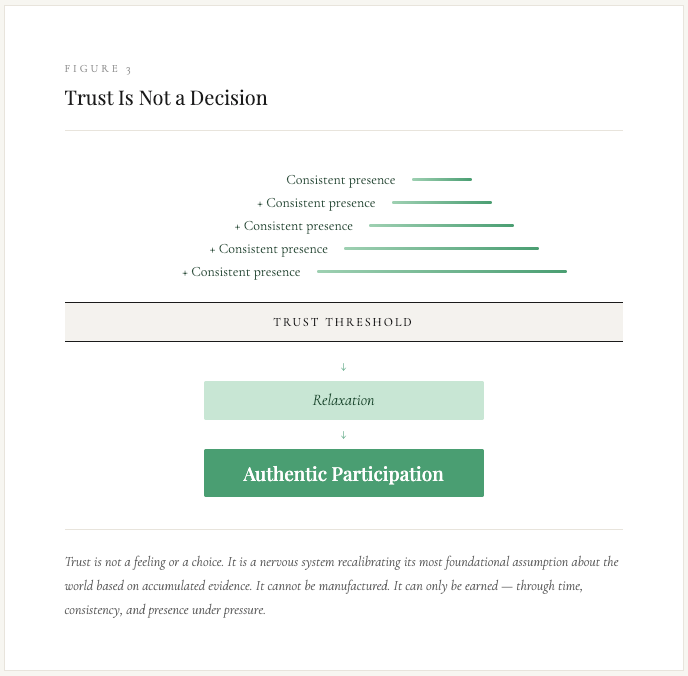
I can’t think of a better definition of trust than that. Not a decision. Not a choice. A nervous system recalibrating its most foundational assumption about the world, that the people around me will remain present, that needs will be met, that relaxing is safe, based on nothing more than accumulated evidence that it was true.
That recalibration happened before he had language, before he had memory, before he had any conscious framework for understanding what was changing. That tells you something important about what trust actually is and where it actually lives.
Trust is not an emotional preference. It is not a personality trait or a cultural value or a management philosophy. Trust is the load-bearing layer that determines whether signal can move safely through a system at all. And it forms , or fails to form, through exactly the mechanism my son’s body demonstrated: repeated exposure to consistent evidence that authenticity will not destroy belonging.
When that evidence accumulates, the body relaxes. The signal moves. Authentic participation becomes possible.
When it doesn’t, the body stays rigid. Not as a choice. As the only rational response to an environment that has not yet demonstrated it is safe.
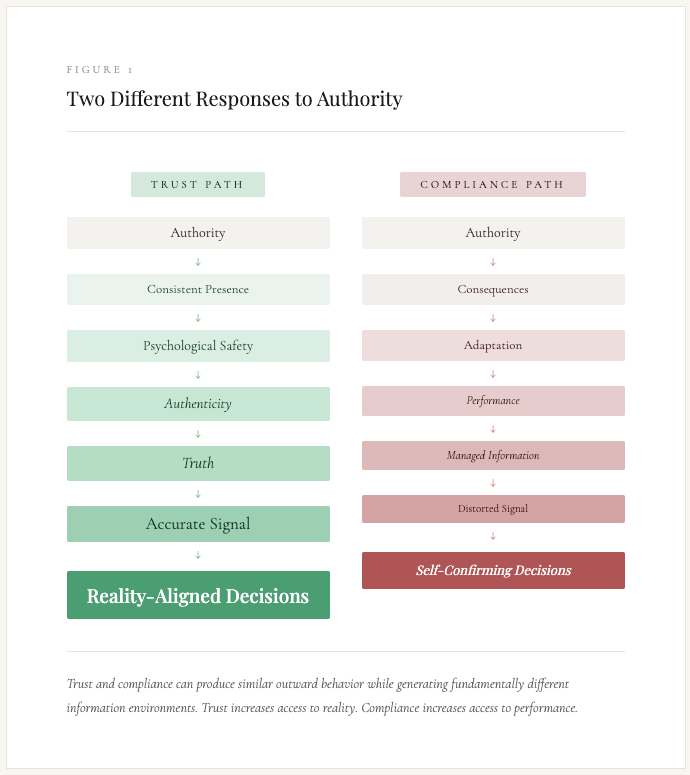
Most people understand trust between equals. The friendship that deepened through a disagreement that survived. The collaboration that became genuine after a conflict was navigated honestly. Peer trust is hard to build but at least structurally supported — neither person holds formal power over the other, neither is being evaluated by the other, neither depends on the other’s assessment for access to the things they need.
Trust between people with unequal power is harder. Significantly harder.
The power differential between a manager and the people they manage, between a teacher and their students, between a doctor and their patients — these are not incidental features of those relationships. They are structural requirements neither party can escape. The person with authority has something the other person needs. The person without authority is dependent. And dependence creates vulnerability. Vulnerability creates the conditions under which trust either forms or permanently fails to.
Institutions understand this. That’s why they’ve built formal architecture around every authority relationship — HR policies, performance management frameworks, professional ethical codes, documentation requirements, therapeutic boundaries. Every one of these exists to prove the relationship has not crossed into something indefensible. The potential for exploitation is real. The architecture is designed to prevent it.
But here is what the architecture also does, as a consequence of doing what it was designed to do: it keeps the authority relationship at exactly the distance required to prevent harm. And that distance happens to also be exactly the distance that prevents genuine trust from forming.
Trust between people with unequal power requires something the formal architecture is specifically designed to eliminate: a genuine human presence across the power differential. The manager who is genuinely present with the people they manage. The teacher who sees their students as full human beings rather than academic cases. The doctor who understands the person’s actual experience rather than managing their symptoms.
Every institutional boundary that protects against exploitation also increases the distance between the authority and the person. And distance is the enemy of trust. Trust forms through proximity, consistency, and the accumulation of evidence that the person with power will not use it to harm the person without it.
There is a version of trust that isn’t trust at all.
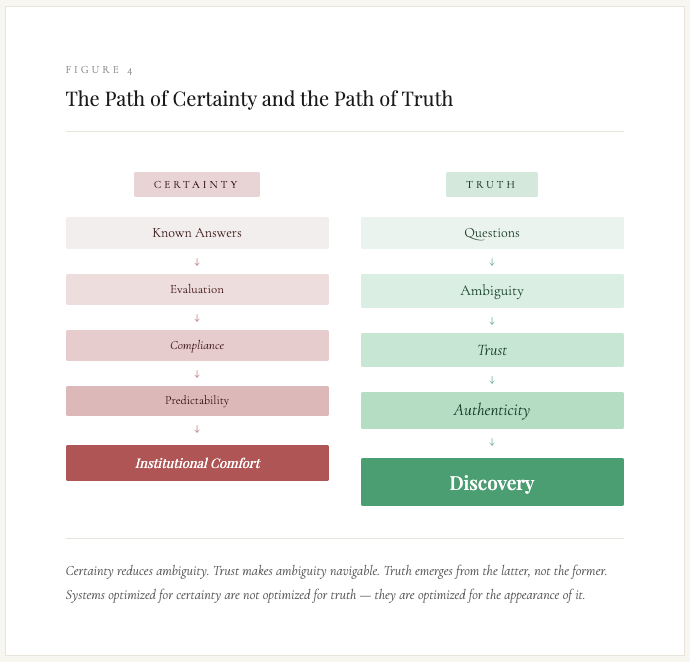
The corporate trust fall — the team building exercise where you cross your arms and fall backward into the arms of a colleague — is designed to feel like trust. It is not. Everyone in the room already knows no one will let you fall. The outcome is controlled. The risk is bounded. The script is known. What the exercise produces is the feeling of trust without the conditions that make trust necessary.
That is certainty masquerading as trust.
Real trust exists precisely because certainty is unavailable. My son did not know we would remain. He had no way of knowing. He accumulated evidence over two months that we probably would — that the pattern was consistent enough, present enough, that the most rational recalibration of his foundational assumption was toward safety rather than vigilance. Trust emerged in the space where certainty was impossible. It could only emerge there. Certainty would have made it unnecessary.
The same is true in every authority relationship worth having. People do not trust their managers because they know exactly what will happen if they surface a difficult truth. They trust because they have repeatedly observed that the relationship survives honesty — that friction, disagreement, and vulnerability have not historically produced exile. The trust is real precisely because the outcome was never guaranteed. The pattern demonstrated it anyway.
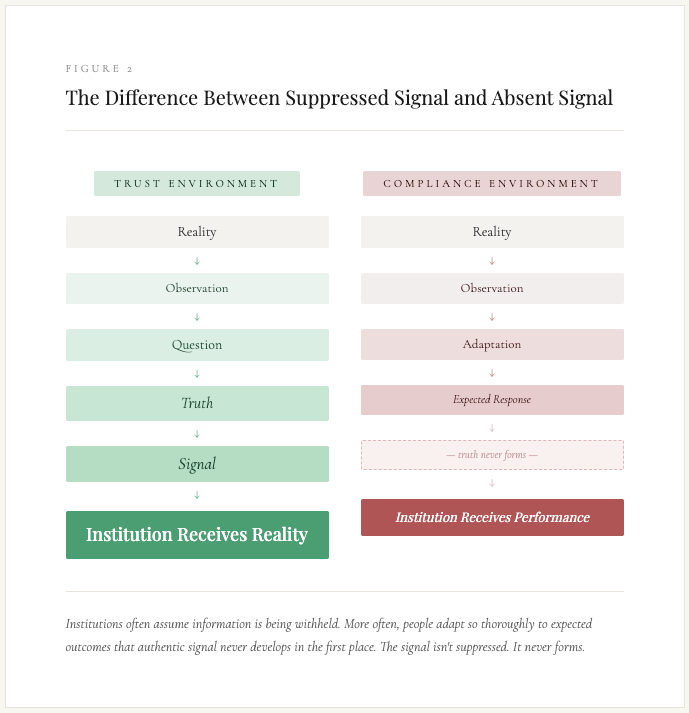
This is why institutional architecture that optimizes for certainty systematically destroys the conditions under which trust can form. A system organized around predictable outcomes, controlled environments, bounded risk, and known scripts is a system that has eliminated the space where trust lives. It has replaced trust with compliance — which looks the same from the outside and produces entirely different signal.
Compliance is certainty made behavioral. Trust is ambiguity survived together.
The result is institutions full of authority relationships that produce compliance but not trust. People who tell their managers what their managers want to hear because the alternative has consistently produced bad outcomes. People who manage their doctors rather than trusting them. People who perform wellness rather than surfacing difficulty. People who give teachers the answers that will be evaluated rather than the questions they actually have.
The signal stops moving upward. The institution loses access to the reality of the people inside it. It makes decisions based on managed information from people who learned long ago that honesty in authority relationships is not safe. This was already happening before artificial intelligence entered the picture.
AI is now being inserted into authority relationships at scale. Performance management systems that evaluate employees. Hiring algorithms that screen candidates. Predictive systems that assess risk in medical, legal, and educational contexts. In every case, the authority relationship now includes a system that is entirely procedural.
A human manager, even one operating inside a formal architecture that discourages genuine presence, can still choose to collapse the distance. Can still tell you something the system doesn’t want you to know. Can still receive a signal the institution wasn’t designed to carry. They can still demonstrate, through the accumulation of consistent behavior under pressure, that the relationship will hold when honesty creates friction.
The algorithm cannot make that choice. It has no presence to collapse. It has no relational history to draw on. It cannot update its baseline assessment based on the human reality in front of it. It processes the signal it was trained to process and produces the output its architecture was designed to produce.
For the person on the other side of that authority relationship, the question that determines whether signal moves — is this relationship stable enough to hold what I’m about to say — has a structurally certain answer.
No.
Not because the algorithm is malicious. Because the architecture of trust formation requires something the algorithm fundamentally cannot provide: the accumulated evidence of consistent human presence under pressure.
My son’s body needed two months of consistent evidence to relax.
The algorithm will never provide that evidence. And the systems being built around it are not designed to ask whether the absence of that evidence matters.
It does.
It is the load-bearing layer everything else depends on.
And we are building civilization’s most powerful systems on top of its absence.
Other recent posts:
Ted Lasso and the Psychology of Grace

When Ted Lasso became culturally popular, most people explained it through optimism. His positivity is addictive, people said.
Grace

My friend died by suicide in February. She got in her car, drove to a nearby park, and shot herself. It wasn’t entirely an unexpected decision, she had been unravelling for months. Unreachable. Her recent actions had been motivated by things that those who loved her couldn’t understand or translate.
link