

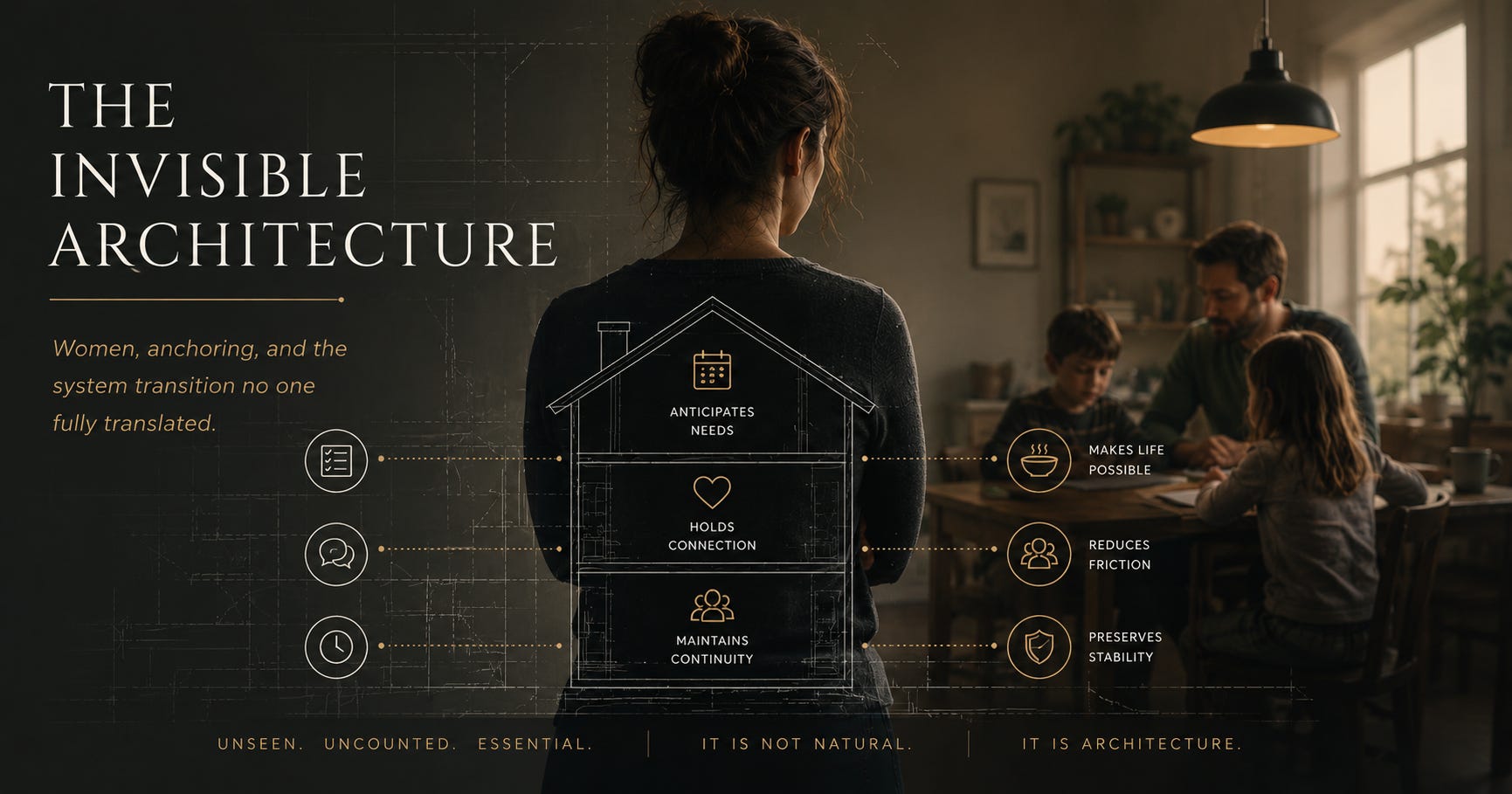
For most of modern history, women quietly carried enormous amounts of invisible interpretive labor inside family systems. They acted as anchors long before we had language for what anchoring actually was.
This was never simply childcare, housework, or emotional support. It was the labor of preserving relational coherence itself. Women were the translators of emotional conflict, the holders of continuity, the anticipators of destabilization, and the interpreters of relational strain. They carried the invisible cognitive work of keeping people understandable to one another over long periods of time, and along with it they coordinated their calendars, did the grocery shopping, cooked, cleaned, and generally held the household together in essential and rarely acknowledged ways.
This labor was implicit and indirect, and therefore largely invisible to the systems depending on it. The work required to hold families, and by extension society, together was simply assumed to exist. Families “worked” because enormous amounts of interpretive stabilization were happening continuously beneath the surface. Stability was experienced as natural rather than maintained.
It bears repeating: for something to be both essential to system architecture and implicitly assumed is a profoundly dangerous place to be. Systems cannot adapt coherently to the loss of functions they never consciously modeled in the first place. When invisible structures are dependencies for stabilization and they begin eroding, the result does not appear as the removal of a specific function. It appears instead as generalized chaos. Everything begins feeling more fragile, more exhausting, more conflict-driven, more psychologically expensive. Trust degrades. Coordination weakens. Relational strain intensifies. The system itself starts feeling increasingly difficult to live in. It looks and feels like everything is breaking down because the stabilizing force was invisible to the system. It was assumed, so no one can identify exactly what was lost.
The feminist movement did not emerge because women suddenly stopped valuing families, relationships, or care. It emerged because generations of women increasingly realized they had been structurally assumed into roles requiring enormous amounts of invisible labor without meaningful autonomy over whether they wanted those roles to define their entire lives.
Understood systematically, women began extending themselves the same interpretive grace they had historically extended toward everyone else. For generations, women were expected to absorb complexity, stabilize relationships, preserve continuity, and quietly hold family systems together, often without equivalent freedom to define themselves outside those functions.
The feminist movement fundamentally disrupted that arrangement. Women increasingly refused premature interpretive closure around what their lives were supposed to become — they simply refused to enter the system as it was defined for them. They instead pursued education, autonomy, careers, political participation, creative identity, and self-definition not simply because they rejected family structures, but because they no longer accepted that relational service alone should define the boundaries of female existence. The result was the gradual emergence of a new system — one that allowed for a woman’s identity to have explicit value alongside the implicit. The previous system had quietly and inaccurately assumed women would continue carrying enormous amounts of invisible burden indefinitely. It is simply unfortunate for society that the invisible burden was actually a stabilizing force.
As a result, the dependence on the labor itself never disappeared. Human systems still require anchoring because someone still has to preserve continuity, translate conflict, absorb ambiguity, stabilize relationships, and keep people understandable to one another over long periods of time. Without that function, the system breaks down. I think that’s one thing everyone universally agrees is required, regardless of political affiliation. The feminist movement did not eliminate the need for that work to be done. It simply made clear that women were no longer willing to carry it automatically, invisibly, and alone.
What emerged afterward was not the removal of the anchor function, but the expectation that it would become a shared responsibility inside a newly evolving system. The difficulty is that systems rarely evolve evenly. Women adapted rapidly into expanded forms of identity, autonomy, education, and public participation, while many men remained psychologically organized around older relational assumptions that no longer matched reality. The result was not simply political tension. It was systemic misalignment, and friction. Lots and lots of friction.
Even still, society feels fragmented — like something is loose that shouldn’t be. Couples mired in resentment, tension, and blame fill therapists’ offices. Marriage went from a systematic expectation to one choice of many options. Political parties decry the collapse of the nuclear family. And in some places, legislation has begun slowly eroding the autonomy women spent generations fighting to establish — as though the solution to a missing stabilization function is to force the people who used to carry it invisibly back into the roles they left.
That is not a translation layer. That is a system attempting to restore a dependency it never learned to redistribute.
These reactions are not surprising, they’re systematically expected when a removed dependency has no definition. But this friction is signal. It’s the result of a missing translation layer between two different, coherent systems. To build a translation layer here, you must make the implicit stabilization labor explicitly defined.
What does that mean? Well, it means you stop doing all the work that comes naturally to you without explaining it first. I realize every person reading this who is also acting as an anchor in a relationship took a collective deep breath, and I get it. Yes, it does mean you have a lot more work to do in the short term, and it means you have to deliberately let things fail and fall through the cracks for a while. Doing that makes things feel unsafe and unstable, and good anchors hate that. But, if you really want a shared anchor relationship, it’s necessary.

The difficult part is that most stabilizing labor does not feel like labor while you’re carrying it. It feels like responsibility. It feels like love. It feels like preventing problems before they become visible enough to hurt the people around you. You remember the permission slip because if you don’t, your child experiences the consequence. You remember the birthday because forgetting it creates relational friction that someone will eventually have to absorb. You make sure dinner exists because hunger, exhaustion, and disorganization compound into tension over time. You monitor schedules, emotional shifts, grocery inventory, appointments, school emails, social obligations, and dozens of other moving pieces because allowing too many of them to fail simultaneously destabilizes the entire household.
Over time, this creates a dangerous illusion: that stability is natural. It isn’t. Someone is maintaining it constantly.
The reason this transition feels so deeply uncomfortable is because good anchors experience preventable instability as personal failure. When you are accustomed to carrying continuity implicitly, deliberately allowing something to fall through the cracks feels negligent, even cruel. Your nervous system interprets the instability as danger because for years, maybe generations, your role inside the system was to prevent exactly that feeling from reaching anyone else.
But if every missed responsibility is intercepted before another person fully experiences the consequence of carrying it themselves, the system never adapts. The labor remains invisible because the absence of that labor never becomes visible long enough for anyone else to recognize what was being maintained in the first place.
In this sense, the feminist movement only completed half the transition. Women were told they could pursue education, careers, autonomy, ambition, leadership, financial independence, and self-definition alongside the traditional stabilizing responsibilities they had already been carrying for centuries. What they were not told clearly enough is that systems do not redistribute invisible labor automatically. Someone still performs it. Someone still absorbs the cognitive load. Someone still maintains continuity.
For decades, women were effectively told they could “have it all,” while quietly continuing to perform most of the implicit stabilizing work underneath the system itself. The result was not liberation. It was overload.
The claim was never sustainable because the problem was never access to opportunity. The problem was that the invisible labor remained invisible. Society encouraged women to expand their explicit responsibilities without fully relinquishing the implicit ones, and because good anchors are deeply uncomfortable allowing instability to surface, many women simply continued absorbing both.
But no human being can indefinitely operate as the full-time stabilizer of a household, relationship, family system, social structure, and career simultaneously without eventually accumulating enormous cognitive and emotional debt. The system only appeared functional because the overload was being privately absorbed faster than it could become publicly visible.
That is the part we still do not talk about honestly enough. This is the paradox of shared anchoring: the original anchor must temporarily tolerate more visible instability in order for the system itself to become more stable long term.
That does not mean the goal is chaos, punishment, or withdrawal. It means the goal is visibility. The forgotten birthday is no longer silently repaired before anyone notices. The missed form is no longer automatically handled by the person already carrying everything else. The emotional temperature of the household is no longer managed entirely by one nervous system operating continuously in the background. Other people must begin directly experiencing the friction required to understand the labor itself.
Only then can the responsibility become shared instead of assumed.
For clarity: I am using the traditional nuclear family as a reference point because it provides the most historically recognizable architecture for describing these dynamics. The underlying mechanics apply across relationship structures. It is simply the system I know most intimately and can describe most accurately.
For centuries, much of women’s labor inside family systems operated implicitly. Women learned to preserve continuity by tracking, anticipating, translating, and stabilizing constantly moving relational systems in real time. The work was rarely linear and almost never fully explainable because explaining it in detail often required more cognitive effort than simply carrying it.
The children, the calendars, the emotional dynamics, the food, the schools, the social continuity, the household management, the invisible anticipatory labor required to keep daily life coherent — all of it frequently existed as ongoing interpretive maintenance rather than explicit procedural work. The better this labor functioned, the less visible it became.
Historically, many men occupied more externally structured system roles. Their responsibilities were often organized around explicit hierarchies, measurable outputs, procedural clarity, economic provision, and institutional navigation. Those systems rewarded linear explanation, specialization, delegation, and clearly transferable knowledge structures.
Inside a more traditional family architecture, these differing adaptive pressures created complementary but asymmetrical systems. Women often became responsible for preserving internal relational coherence while men became responsible for navigating external institutional structures that maintained material stability.
Even many common relationship frustrations reflect this divide. The longstanding complaint that men try to “solve” problems that women simply want shared understanding around is not random interpersonal incompatibility. It reflects generations of role conditioning inside systems rewarding different forms of cognition, translation, and responsibility.
In my own marriage, I was constantly frustrated by this dynamic until very recently. My husband always asked for explanations for things I felt he should have been able to figure out on his own, and I didn’t think it was fair that I had to spend additional energy explaining work I already didn’t have time to carry. To me, the need itself felt like evidence that he wasn’t paying attention. If I could see what needed to happen automatically, why couldn’t he?
Now, though, I understand the problem differently.
He needed the explanation as much as I needed the work to move to him because the explanation itself is the translation layer. It is the mechanism that moves stabilizing labor from implicit awareness into explicit participation. Much of the work I was carrying had never actually become visible enough for another person to fully enter into it. I was assuming shared perception where none existed because I had spent so many years operating continuously inside the system that the patterns felt self-evident to me.
Once he started seeing the invisible work, he naturally began picking up more of it. Not because I forced him to, and not because he suddenly became a different person, but because awareness itself changed his relationship to the system. His attention expanded to include many of the small, continuous tasks required to keep family life coherent over time, and mine slowly loosened around the assumption that I alone was responsible for holding all of it together correctly.
That shift was stranger than I expected. Yes, sometimes the laundry and dishes pile up more than my nervous system prefers. Sometimes things happen later than I would have handled them myself. But my awareness of those imperfections no longer hooks into me with the same urgency it once did. The instability still exists, but it no longer feels like an immediate personal responsibility I must absorb before anyone else experiences it.
That is a real change, and honestly, I think many women have never experienced that shift deeply enough to realize how much cognitive energy they were spending continuously monitoring systems that everyone else simply experienced as “life working normally.”
The difficult part of moving implicit systems into explicit ones is that the transition itself feels destabilizing — it takes labor that there isn’t often time to do, and that labor falls again on the anchors because they’re the only ones who actually understand the implicit effort. The moment that labor becomes visible, the system temporarily feels less stable because people are suddenly confronting responsibilities they previously experienced only as seamless outcomes.
That destabilization is not failure. It is translation.
Other people will carry anchoring responsibilities differently than you would have, and that difference can feel deeply uncomfortable when you are accustomed to preserving continuity yourself. Good anchors often experience deviations from their own internal systems as danger signals because they are used to monitoring stability constantly.
But different is not the same thing as broken.
Shared anchoring requires allowing other people to develop their own interpretive pathways into the labor. That means tolerating inefficiency, inconsistency, missed details, and imperfect translation for a while. It means resisting the urge to immediately retake control every time the system feels less optimized than it once did under unilateral management.
I learned this almost entirely by accident. There was a period at work where I traveled constantly and physically could not carry the implicit loads I normally managed at home. My husband had to pick them up because there was no alternative. And he did. Beautifully, imperfectly, and often very differently than I would have done it myself. But perfect replication was never the goal. The goal was shared participation in the work itself.
The point was that he understood. He saw, at least partially, what I carried invisibly because things started breaking without me, and he entered the system voluntarily to pick up part of the load without requiring me to continue acting as the invisible infrastructure underneath it all.
That is what shared anchors do.
Men are increasingly learning forms of relational translation they were historically less expected to perform. Women are increasingly refusing automatic assignment into invisible stabilizing labor without recognition, reciprocity, or choice. The transition is messy because systems adapt more slowly than identities do.
But shortening the interval matters. Long intervals create confusion, resentment, exhaustion, and conflict because people continue reacting to symptoms while remaining unable to see the underlying architectural shift itself. The faster implicit labor becomes visible, translatable, and shared, the faster systems regain stability. We cannot redistribute responsibilities that remain invisible, and we cannot expect people to participate coherently inside systems they were never taught to see.
The solution is not blame. It is a translation layer.

The deeper lesson may be that healthy systems never depended on women being naturally sacrificial. They depended on anchoring, and anchoring remains necessary anywhere human beings are trying to survive complexity together.
other recent posts:
Grace

My friend died by suicide in February. She got in her car, drove to a nearby park, and shot herself. It wasn’t entirely an unexpected decision, she had been unravelling for months. Unreachable. Her recent actions had been motivated by things that those who loved her couldn’t understand or translate.
Ted Lasso and the Psychology of Grace

When Ted Lasso became culturally popular, most people explained it through optimism. His positivity is addictive, people said.
Link
Perfect way to describe the psychological reasons behind this. Thank you for shedding light on it!