

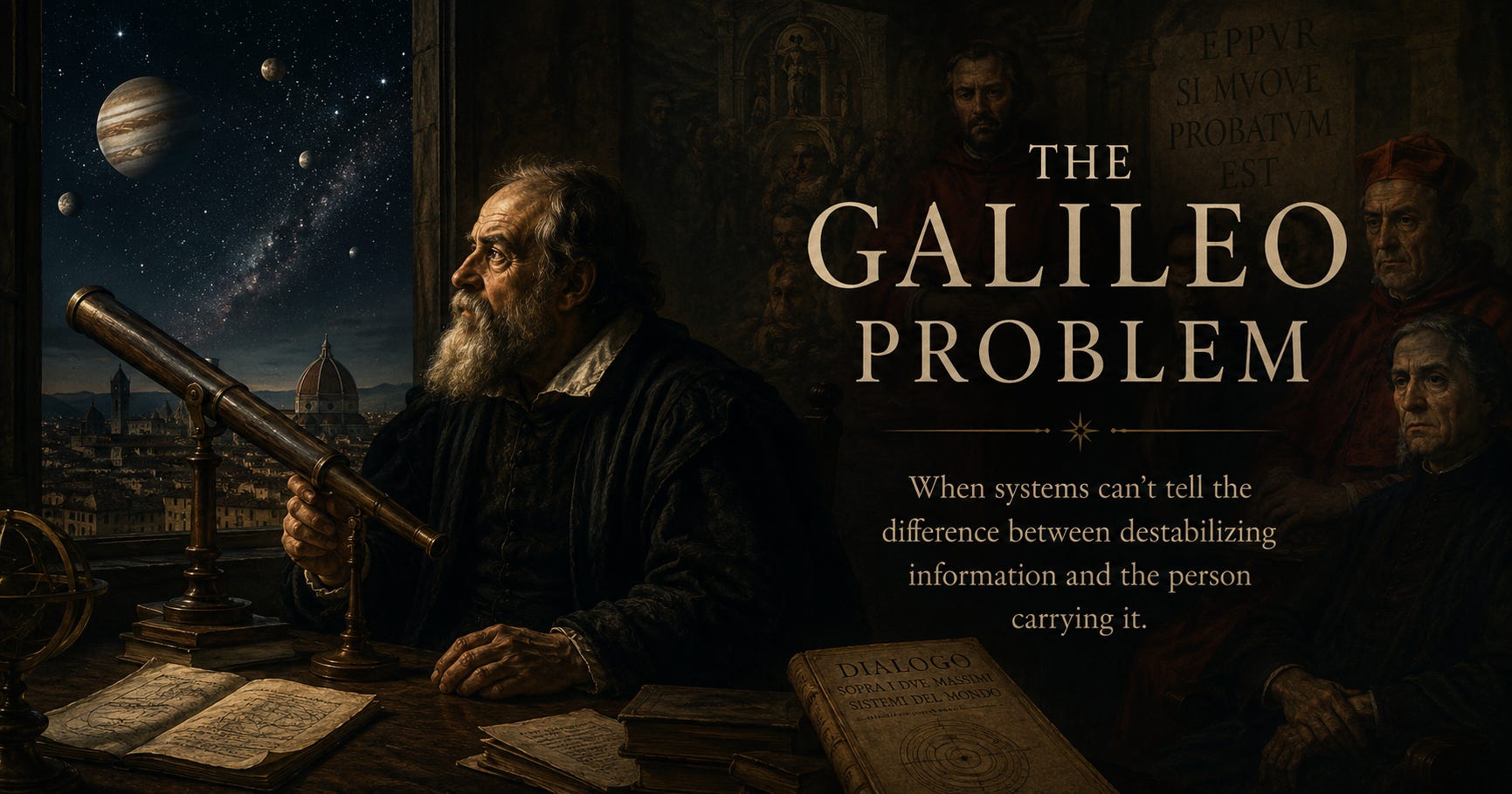
Galileo is remembered as a story about science and religion. About heliocentrism, heresy, and a Church unwilling to accept the truth.
But that has never been the part of the story that stayed with me.
What stayed with me was the structure.
If you think about it practically, Galileo probably did not experience himself as a revolutionary at first. He was a mathematician, an astronomer, a man obsessed with observation. When he turned his telescope toward Jupiter and saw moons orbiting something other than Earth, he was not looking for a fight with the Catholic Church. He was looking at the sky.
What he saw must have felt exhilarating, not because it proved him right, but because reality had suddenly become larger than the model explaining it. The universe was moving in a way the existing structure could not fully account for, and for a moment, that realization must have felt almost joyful.
People imagine Galileo as confrontational. Defiant. A man standing in opposition to the Church from the beginning.
I doubt it felt that way to him.
I think it started with awe. He found actual proof that not everything revolves around the Earth. The universe is bigger and stranger and more alive than the model he inherited. How could you not want to tell people?
That’s the part of the story that matters to me most. The excitement came first. He wasn’t trying to destabilize the Church. He was trying to share what he saw.
And for a while, he probably believed the observation itself would carry the day. After all, his discovery really was awe inspiring — expansive in a way few discoveries are. I’m sure he believed that reality, once visible enough, would reorganize the system around it naturally. It’s reasonable to have faith that if something is demonstrably true, the people surrounding the truth would want to move toward it too.
Most people who trigger the Galileo problem seem to believe that initially.
Think about the employee who points out the flaw in the strategy or the person in the family who finally names the tension everyone else has organized themselves around avoiding, or the woman entering an institution believing her warmth, capability, and sincerity will be welcomed because the institution publicly claims to value those things.
At first, they are responding to the signal itself. The thing that feels alive. The contradiction they can suddenly see clearly. The possibility that something could become more accurate, more honest, more real. They do not yet understand that they are also exerting pressure on the structure surrounding them. By the time they realize that, the structure has often already started responding not to the observation, but to them.
Galileo likely believed the observation itself mattered most. That if something could be demonstrated clearly enough, carefully enough, reality would reorganize around it. But here’s the thing — systems do not reorganize around truth automatically. Authenticity and tenacity cannot carry truth to light in a system unprepared to receive it. Especially systems whose legitimacy depends on coherence.
The Church was not simply preserving doctrine. It was preserving an entire structure of meaning. Authority. Interpretation. Stability. The Earth sitting at the center of the universe was not just a scientific claim. It was part of a larger architecture explaining humanity’s place in creation itself, and Galileo’s discovery introduced pressure into that architecture.
At first, the pressure was attached to the observation. The data. The telescope. The argument. But it didn’t stay there. Over time, that pressure became attached to him.
That shift is the part of the story that has never left me.
There is a moment in systems under strain where the distinction between destabilizing information and the person carrying it begins to collapse. The individual stops being experienced as someone observing tension inside the system and starts being experienced as the source of the tension itself.
I don’t think Galileo initially understood that he was operating inside that kind of structure. If he did, he almost certainly wouldn’t have studied what he did, and he definitely wouldn’t have released his findings with the joy and excitement he did. To do such things, people need to believe the system they are inside is oriented primarily around accuracy, fairness, truth, performance, or shared reality.
That belief holds until suddenly they feel it begin to constrict around them. And by the time they recognize what is happening, interpretation has already started hardening.
That pattern is everywhere.
It exists in organizations that label friction as dysfunction rather than investigating what the friction is revealing. It exists in families that slowly reorganize themselves around one person becoming “the problem” until every tension, conflict, or instability bends toward them regardless of its original source. It exists in institutions that cannot distinguish between the person creating instability and the person exposing it.
The Galileo problem is not simply that systems reject truth.
It is that systems under pressure often reinterpret adaptive or destabilizing signal as a threat to coherence itself. Once that happens, something dangerous begins.
The signal collapses inward around the person carrying it.
More and more complexity becomes legible through them. Friction becomes personality. Disagreement becomes disruption. Exhaustion becomes evidence. Eventually the person stops being interpreted as someone navigating pressure and starts being interpreted as the pressure itself.
This is not always malicious. In fact, it rarely feels malicious from inside the system. Most institutions experience themselves as preserving stability, continuity, legitimacy, or fairness. The Church was not merely protecting doctrine. The monarchy is not merely protecting tradition. Organizations are not merely protecting hierarchy, they are protecting coherence. The problem is that systems often experience adaptive pressure as destabilization long before they recognize it as evolution. Sometimes that interval takes three hundred and forty-seven years.
And so the same pattern repeats.
A capable employee raises concerns that become increasingly costly to hear. A woman enters a symbolic institution carrying exactly the charisma and emotional fluency the institution publicly claims to value until the public responds too strongly and the system begins reorganizing itself around containing her. A family slowly hardens around one member becoming the interpretive center of every unresolved tension inside it.
Once you see the pattern, it becomes difficult to stop seeing it.
The tragedy of the Galileo problem is not simply exclusion. It is interpretive isolation.
It is the experience of realizing that the surrounding system no longer has the capacity to metabolize your signal safely. That no amount of explanation restores the original context. That more and more meaning accumulates around you until eventually the distinction between the pressure and your identity itself begins to disappear. Human beings are not built to survive that indefinitely.
What fascinates me is that some systems do survive it.
Some relationships remain stable enough to interpret friction before it hardens into threat. Some leaders absorb complexity without collapsing into simplification. Some environments allow disagreement, adaptation, and ambiguity to remain metabolically safe long enough for growth to occur rather than exile.
That difference may matter more than intelligence.
More than process.
Possibly even more than capability itself.
Because performance is not only determined by what people can do.
It is determined by whether the systems surrounding them can still interpret them accurately once pressure begins to build.
Human beings are not built to survive prolonged interpretive isolation indefinitely.
We survive through relationships, institutions, and environments capable of distinguishing between the person carrying tension and the tension itself. We survive when friction remains interpretable before it hardens into identity.
The systems that endure are not the systems that eliminate pressure. They are the systems that retain enough relational and interpretive capacity to metabolize it without sacrificing the people who first revealed it.
other recent articles:
Adrift

You never know what will trigger a true crisis of self. For me, the most destabilizing force turned out to be — somewhat ironically — myself. It unfolded through a series of events, each one exposing small cracks, until a final accumulation of stressors caused my entire operating system to fail.