

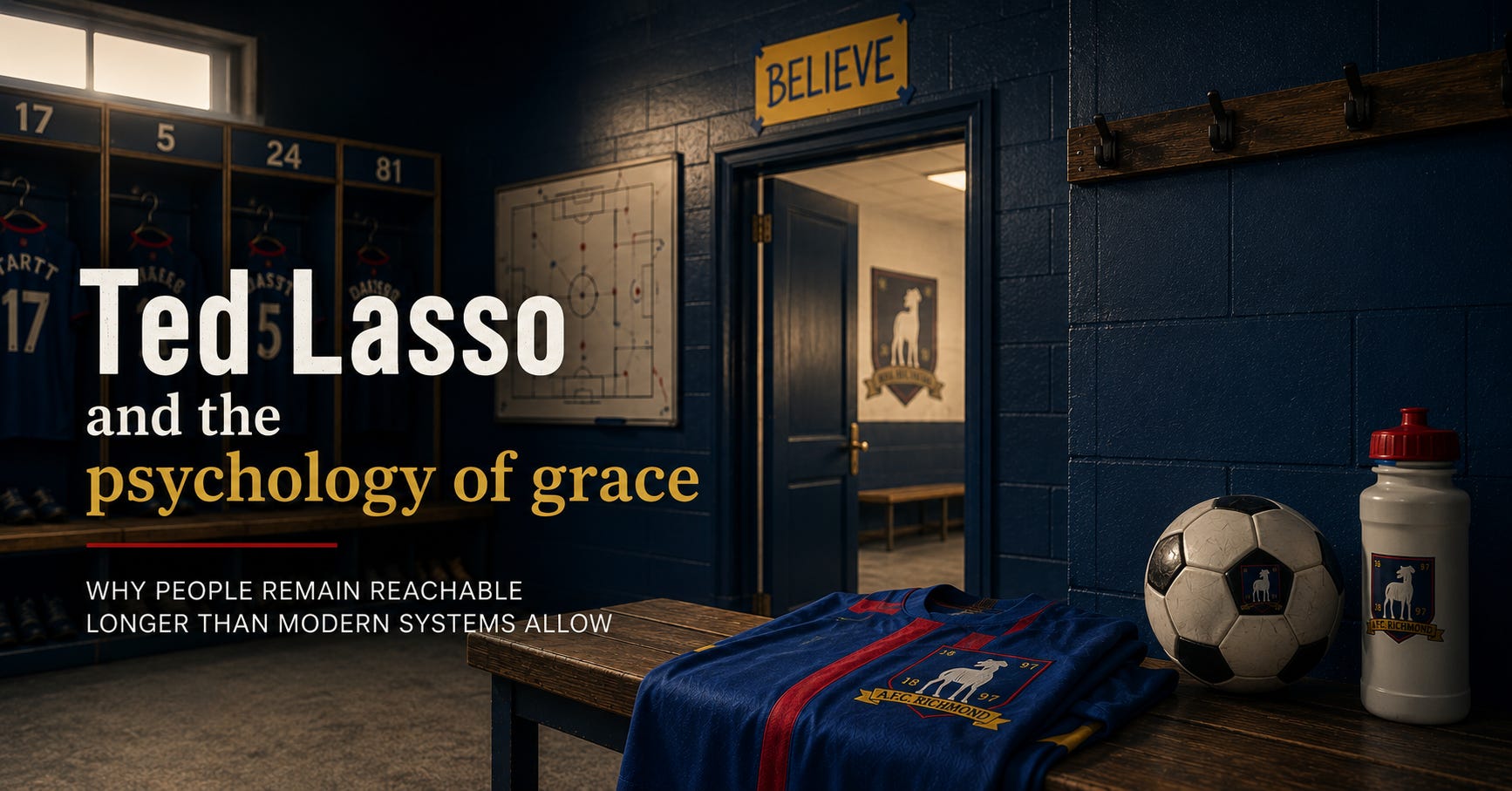
When Ted Lasso became culturally popular, most people explained it through optimism. His positivity is addictive, people said.
The world felt exhausted, cynical, polarized, emotionally brittle, and increasingly incapable of extending warmth to anyone. Then suddenly here was a television show built around a relentlessly kind football coach who believed in people almost to the point of absurdity. The explanation seemed obvious: people were starved for positivity.
I don’t think relentless positivity is actually what people were responding to. Systematic reactions — the kind that produce universal, years-long, cross-demographic devotion — don’t happen unless something deeply needed is being recognized.
Positivity is not deeply needed. In fact, it’s exhausting. Relentless optimism by itself tends to feel emotionally flattening, performative, or psychologically avoidant. Most people know the difference instinctively between someone who is genuinely present with difficulty and someone who is simply refusing to acknowledge it. Forced optimism doesn’t make human beings feel safer. Usually it makes them feel less understood.
What Ted Lasso actually offers is something rarer and more structurally specific than positivity. And that distinction is worth understanding — because the thing people are actually responding to is the thing most systems desperately need and almost never build deliberately. What Ted understood — and what most modern systems increasingly fail to understand — is something much deeper: human beings remain reachable when interpretation stays open long enough for growth to occur.
That is grace.
It is the refusal to collapse another person permanently into the worst interpretation available under pressure, and Ted does this constantly.
He does not deny reality. He sees arrogance in Jamie Tartt immediately. He sees Rebecca manipulating him. He sees Roy’s anger, Nate’s insecurity, Beard’s volatility, and his own exhaustion. But he continues relating to people contextually instead of defensively. He refuses interpretive finality even when the surrounding system keeps offering him reasons to adopt it.
That distinction is why people love the show. It’s why Ted Lasso went from a feel-good long-shot to a cultural phenomenon.
Most systems — especially modern institutional and online systems — reduce people through simplification. Once someone embarrasses themselves, fails publicly, betrays trust, displays insecurity, acts selfishly, or hurts others, public interpretation hardens quickly. The person becomes the worst thing they have done, or the narrowest explanation available for their behavior.
Ted repeatedly resists that process, and because he does, people around him remain psychologically reachable longer than they otherwise would.
Jamie Tartt is one of the clearest examples.
At first Jamie appears emotionally simple: narcissistic, arrogant, selfish, immature, desperate for validation. Most systems would respond to someone like him procedurally. Punish the behavior. Remove the disruption. Flatten him into the role of problem. Ted refuses to do that, not because Jamie’s behavior is acceptable. It often isn’t. But Ted continues relating to Jamie as a person whose behavior isn’t isolated. He credits Jamie as having more context than he’s displaying, and he gives him grace in interpretation. He doesn’t do this sometimes, or when pressure increases. He does this consistently, as a default way of interacting, and it makes an enormous difference. Over time, that interpretive openness creates enough safety for Jamie’s underlying shame, fear, loneliness, and scars of past neglect to become reachable instead of permanently defended. Slowly, Jamie changes. His change isn’t instant, or clean, or linear, but it is human.
Rebecca’s relationship with Ted may be the clearest example of grace operating structurally inside the show.
The show begins with Rebecca attempting to weaponize Ted against the club itself as part of her unresolved grief and rage toward her ex-husband. Ted knows something is wrong long before the truth fully surfaces. But once again, he refuses interpretive collapse.
Instead, he starts bringing her biscuits every morning.
The gesture is almost absurd in its consistency. He asks for nothing in return, and there’s no facet of trust in the relationship when this ritual starts. He simply continues showing up before Rebecca has earned the ability to accept or even recognize that kind of behavior as coming from a place of care. Rebecca’s reaction to Ted’s biscuits is one of the most psychologically accurate things in the entire show.
At first she experiences them as slightly ridiculous, yet another example of Ted’s excessive optimism and emotional strangeness. Then she tastes them, and suddenly the gesture becomes destabilizing. This isn’t because the biscuits themselves matter that much, but instead because they are unexpectedly good in a way that becomes emotionally difficult for her to process cleanly. Rebecca starts trying almost obsessively to figure out where they come from. She needs the answer. She needs the gesture to become procedural again — sourced externally, purchased somewhere, explainable through effortlessness or performance rather than genuine care. Caring can’t be the reason because caring is dangerous.
If the warmth is real, then her existing interpretation of Ted becomes harder to maintain. The system starts loosening. And loosening interpretive certainty is frightening when your previous relationships taught you that vulnerability eventually becomes weaponized against you.
Then she discovers Ted makes the biscuits himself. He makes them quietly and consistently, without asking for anything in return. That revelation removes the last interpretive defense available to her. She can’t reduce his investment of grace to performance, manipulation, convenience, or strategy. It is simply warmth extended repeatedly without demand for reciprocity.
And slowly, against her own instincts, Rebecca begins allowing herself to recognize it for what it is, and she begins to reciprocate. Ted’s openness allows Rebecca to re-enter relationship without first requiring apology or emotional perfection.
That’s a big deal. Human beings do not become more open through forced emotional exile. They harden and become defensive. Grace interrupts that hardening process before identity calcifies completely around shame, fear, resentment, or self-protection.
Nate’s story is painful precisely because Ted extends grace toward him repeatedly, and for a long time Nate cannot fully trust it.
Nate is used to being invisible, inadequate, and humiliated. His understanding of relationships has been shaped by conditional approval and the constant expectation that affection, recognition, or belonging can disappear on the whims of volatile personalities. When Ted enters the scene and changes that, Nate does not experience the new environment as stable. He experiences it as unfamiliar.
Being seen, valued, elevated, and included without having to fight constantly for scraps of approval isn’t actually safe for Nate psychologically. He does not know how to trust a relationship that does not require constant performance, vigilance, or emotional self-protection to maintain. Relational safety is so outside his previous experience that he cannot fully believe it will remain real once disappointment, distance, or imperfection enters the system. Instead of grounding him, the new environment destabilizes him. Every perceived shift in attention starts feeling catastrophic because he has no confidence the connection can survive strain.
In attachment terms, Nate never developed the internal stability that comes from secure connection. His relationships taught him that affection, approval, and belonging were conditional, unpredictable, and emotionally fragile. So even as Ted offers him consistency and grace, Nate continues relating to the connection through insecurity, hypervigilance, and fear of abandonment. That is part of what makes his story so painful. Ted keeps leaving the relational door open, but Nate cannot yet trust that the door will still be there once he disappoints someone on the other side of it.
Over time, Nate becomes increasingly dependent on external validation because he never believes the new system will hold without constant reinforcement. Ted’s care, which initially opened Nate up emotionally, slowly becomes reinterpreted through insecurity, resentment, and fear of abandonment instead. That is what makes Nate tragic. Ted does not stop extending grace toward him. Nate simply becomes less and less capable of believing grace can survive disappointment, distance, or imperfection.
Over time, Nate’s interpretation narrows.
Ted becomes neglectful. Others become dismissive. Success becomes proof he finally matters. Ambition becomes emotional survival, and the loop closes.
Once that happens, even Ted’s very real emotional investment starts getting processed through resentment instead of relationship. The tragedy is not that Ted failed Nate. The tragedy is that Nate slowly lost the ability to interpret Ted relationally at all. The investment was real, but the interpretation distorted it to something manipulative.
That is what closed systems do. They reorganize every signal until only the interpretation capable of sustaining the system emotionally remains.
Even after betrayal, Ted still refuses permanent closure around Nate. This isn’t because he lacks boundaries or because betrayal does not matter, but because grace leaves the door open longer than shame believes it deserves to.
That is the emotional mechanism underneath the entire show.
Roy changes because people continue interpreting him beyond anger.
Rebecca changes because people continue interpreting her beyond grief.
Jamie changes because people continue interpreting him beyond arrogance.
Even Ted changes once other people begin refusing to flatten him into optimism alone.
But one of the most important things about the show is this: Ted himself is not emotionally uncomplicated.
Ted’s grace comes with enormous psychological cost. Grace extended without trust compounds debt. Ted accumulates tremendous debt through giving everyone around him grace he does not give himself.
He processes pressure relationally almost constantly. He absorbs conflict, shame, insecurity, disappointment, anger, projection, and emotional instability from the people around him while continuing to preserve interpretive openness toward them. Over time, that burden would overwhelm anyone — it’s an enormous cognitive load that he bears alone. The show conveys this truthfully by showing Ted’s overwhelmed nervous system. The panic attacks matter because they reveal something essential: grace is not emotionally effortless.
It can be exhausting. It can require carrying uncertainty longer than feels psychologically comfortable. It can require remaining emotionally open while other people temporarily cannot. Sometimes it even requires extending understanding to people before they fully deserve it. When you recognize that permanent closure will only harden the system further, sometimes you’ll sacrifice yourself to keep it open. That’s what Ted does, and he pays a price for it.
Ted Lasso resonated culturally because people are exhausted by environments that interpret human beings without grace.
We live inside systems every day that flatten people into performance, failure, embarrassment, usefulness, ideology, productivity, or their worst moment under pressure. Most modern institutions reward emotional caution, procedural judgment, and defensive interpretation because those responses feel safer, cleaner, and easier to control at scale.
Ted does the opposite.
He continues interpreting people contextually even when they disappoint him. He leaves relational doors open longer than most systems allow. He responds to shame with curiosity instead of immediate exile. And because of that, the show taps into something people are profoundly hungry for without always having language for it.
The show doesn’t convey unconditional approval or naïve optimism. It’s successful because it fosters the feeling that human beings might still remain reachable even after they fail, fracture, disappoint others, or struggle to become who they are capable of being.
The show felt radical not because it believed people were always good.
It felt radical because it believed people remained reachable.
And increasingly, that belief itself has started to feel culturally rare.
other recent work:
Grace

My friend died by suicide in February. She got in her car, drove to a nearby park, and shot herself. It wasn’t entirely an unexpected decision, she had been unravelling for months. Unreachable. Her recent actions had been motivated by things that those who loved her couldn’t understand or translate.
Why The Office Still Feels Human

The Office has been one of my favorite shows for literal decades. What makes it so easy to rewatch and so profoundly funny for me is the public perception of the program. People often describe The Office as a comedy about dysfunction, and it is, superficially. But foundationally, systematically, it is so much more. And the systematic meaning is why …